Wednesday, December 23, 2020

Allstar Node 45333 Garage Repeater.

 Here is my low-powered low-profile garage repeater.

It consists of a RPi3 running the Hamvoip image for Allstar and Controller duties.
The radio interface is a Repeaterbuilder RIMlite-RM (repeater-maker) it has two connectors which plug directly into the 16 pin accessory ports of two motorolas (GM, PM, CM, etc. class) for use in a repeater configuration.
The receiver/exciter combo are two UHF Motorola PM 400's. The duplexer is a vintage UHF Decibel . The power supply is a generic 30A switcher. There is a fan which cools the radio being used for transmit. It has ran in this configuration for over 4 years.
The Kenwood TK-860 is used to monitor the repeater and a simplex UHF node while Im in the garage
The EFJ UHF amplifier and power supplies below the duplexer are not currently in use.
I believe the cabinet is a vintage GE (bought for $25 at the Knoxville Hamfest around 2012.)
Also... Thanks to WB4IVB for waiving his usual consulting fee, tuning of duplexers, etc.
Steve, W4HKL


Friday, June 19, 2020

Autotuned “L” Dipole Portable Antenna System


The “plan.” Create a tunable dipole for 20-6 meters… maybe even get 40 meters added later.


There are at least five or six different brands of remote antenna tuners ranging from SGC, Icom, Alinco, LDG, MFJ… the main idea is to tune the system at the feed point to a low SWR to reduce losses in the coax. That… and I have 4 autotuners laying around, so...
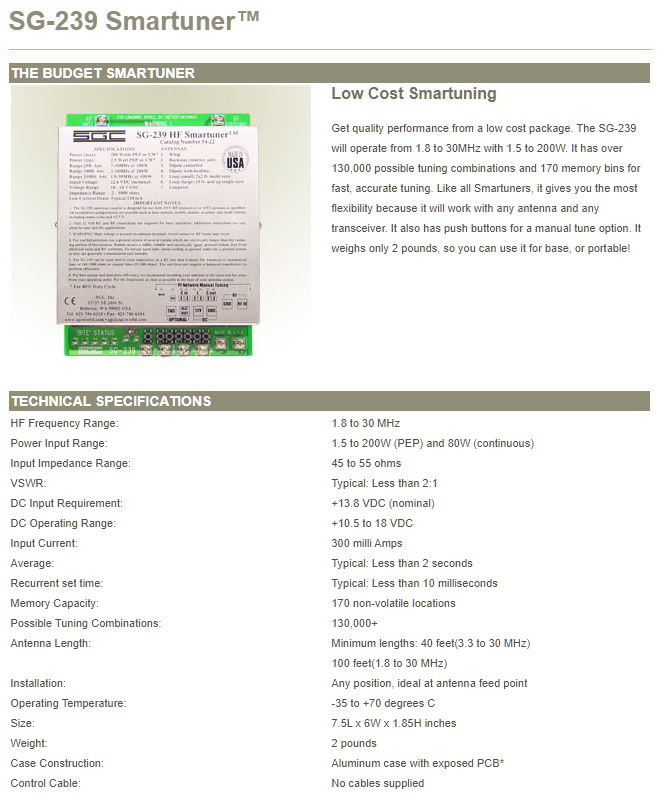


SGC has many different remote tuners or “matchers.” Most radio companies have them, too.


The losses (per 100 ft) given for coax are always calculated with an assumed 50 Ohm load. If you deviate from that the losses can go sky-high with poor SWR… even at HF… even with good coax. So “why fight city hall” when you can just match the antenna at the feed point and be done with it? (At least that’s my thought process.) Besides, remote tuners like the AH-4, etc, are very versatile and can be used for many other antenna applications.


I thought I would start off with an “L” configuration and later move it to a “V” configuration… mostly to reduce turning radius. While the “L” is the smallest turning radius I can get presently, the pattern is really more omnidirectional than a “T” or “V” dipole (according to the literature I can find online concerning the matter.) I plan on fabricating a “V” dipole mount later so that each radiating element is 45 degrees up from the Horizontal (and 90 degrees from one another) - not counting sag (102” whips do tend to sag a bit.) The end goal is to use two 20 meter elements (EMT, fiberglass or bamboo with a 16.5’ wire element loosely wound??) and tune 20 thru 6 meters… instead of taking two 10 meter elements and tuning 20-6 meters. “It’s easier to tune a long antenna short than it is to tune a short antenna long” is the old saying, and I plan on following it.


Here is what I managed to put together in a few hours this weekend.


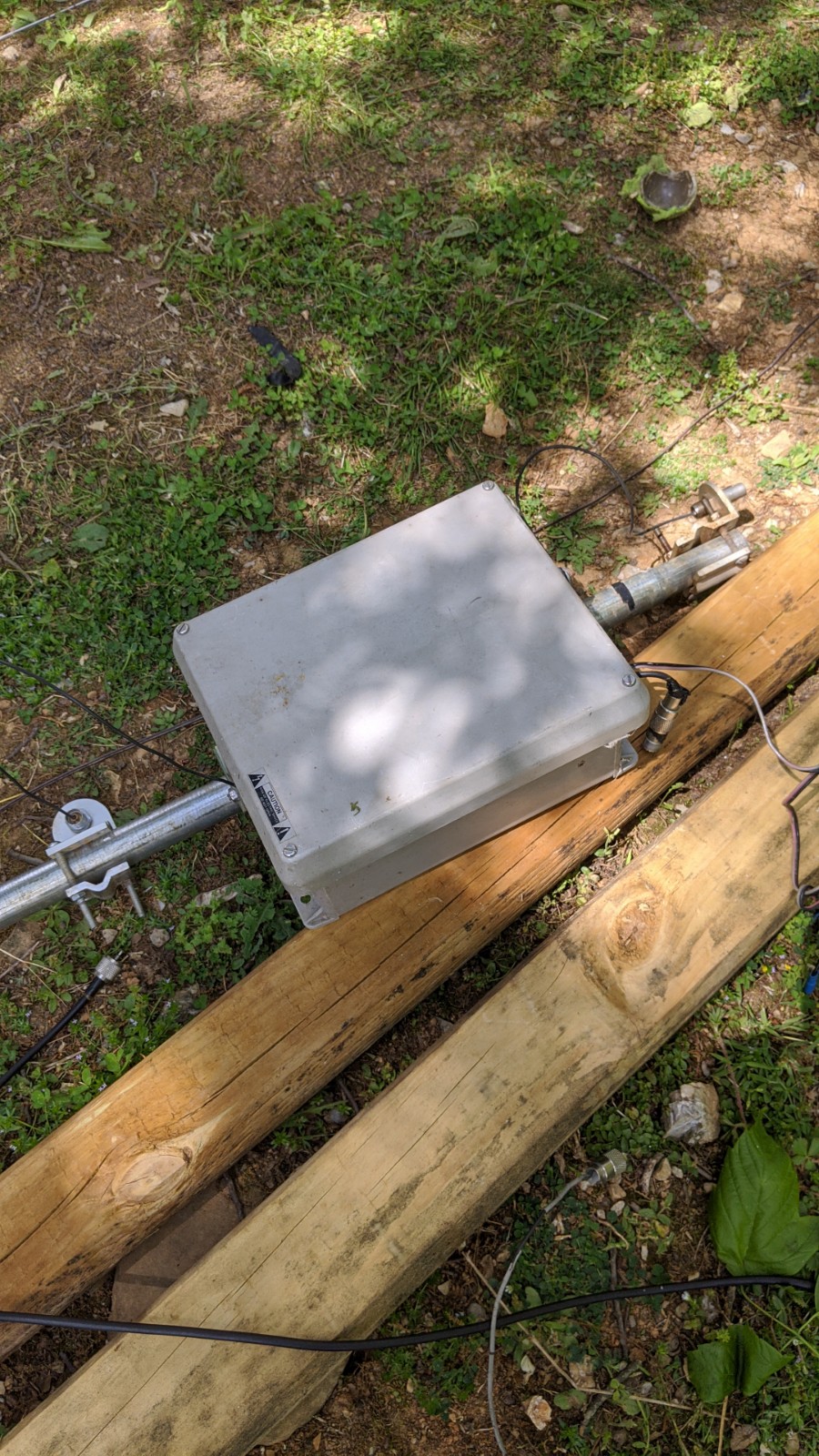
The SGC 239 tuner is mounted in a water-tight NEMA box with the needed leads brought out and water sealed. Note the 8’ fencing post (Home Depot) I’ve mounted it on using two U bolts (the box has mounting flanges on the back) and two “Hamstick” mounts from a local Pilot truckstop. (The bolts diagonal from one another on the ⅜ antenna mounts were removed to make it fit on the main part of the pipe - it will fit correctly on the tapered end, however. )

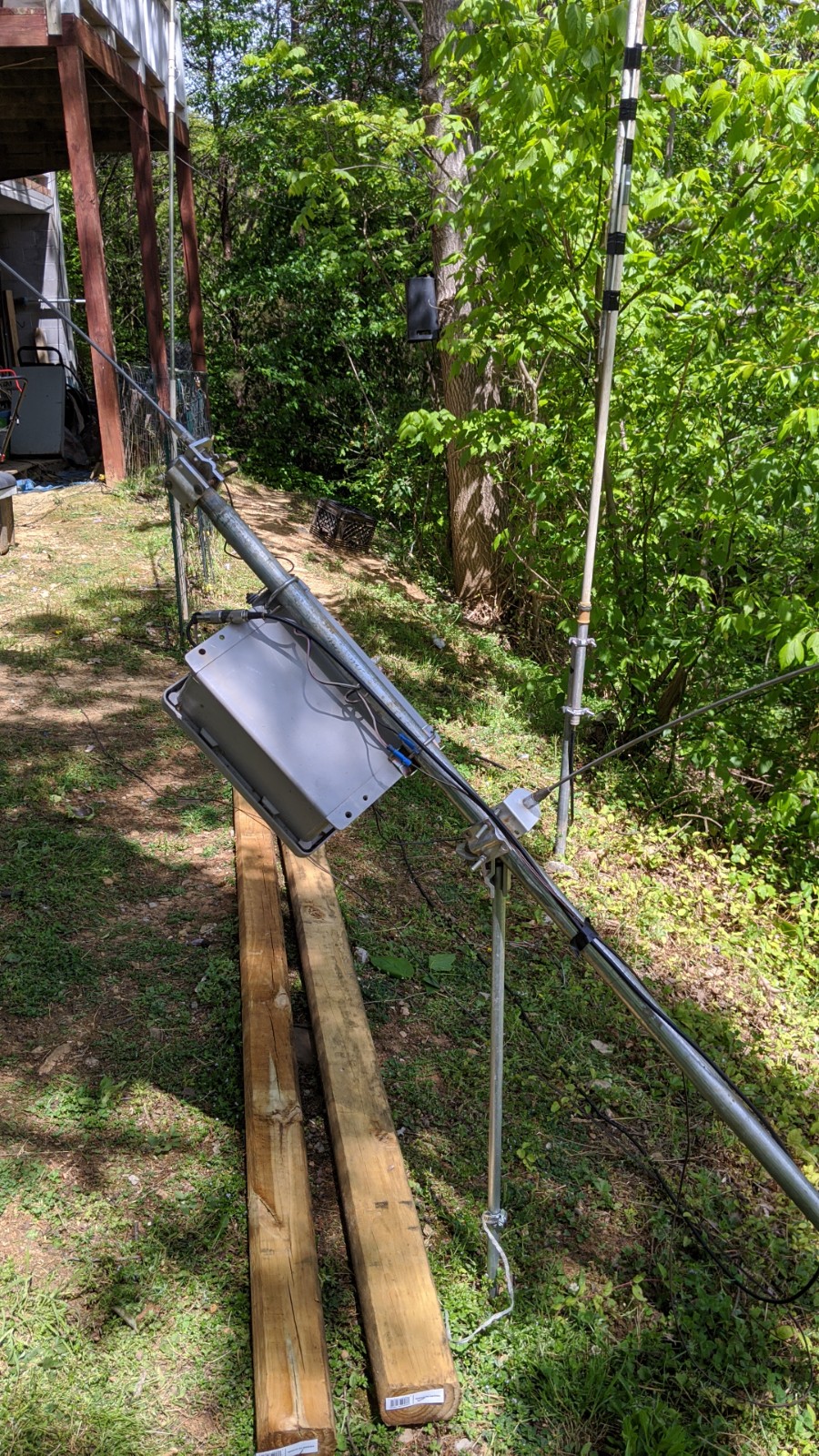


These two pictures show the various mounts from more angles. )Note the Marconi “hamstick” mount being used to hold it up in the picture on the right. And the Antron 99 ground mounted behind it. )


The assembly could be mounted many ways… I am going to slip the 8’ pole over the garden fence “post” as a temporary mount.
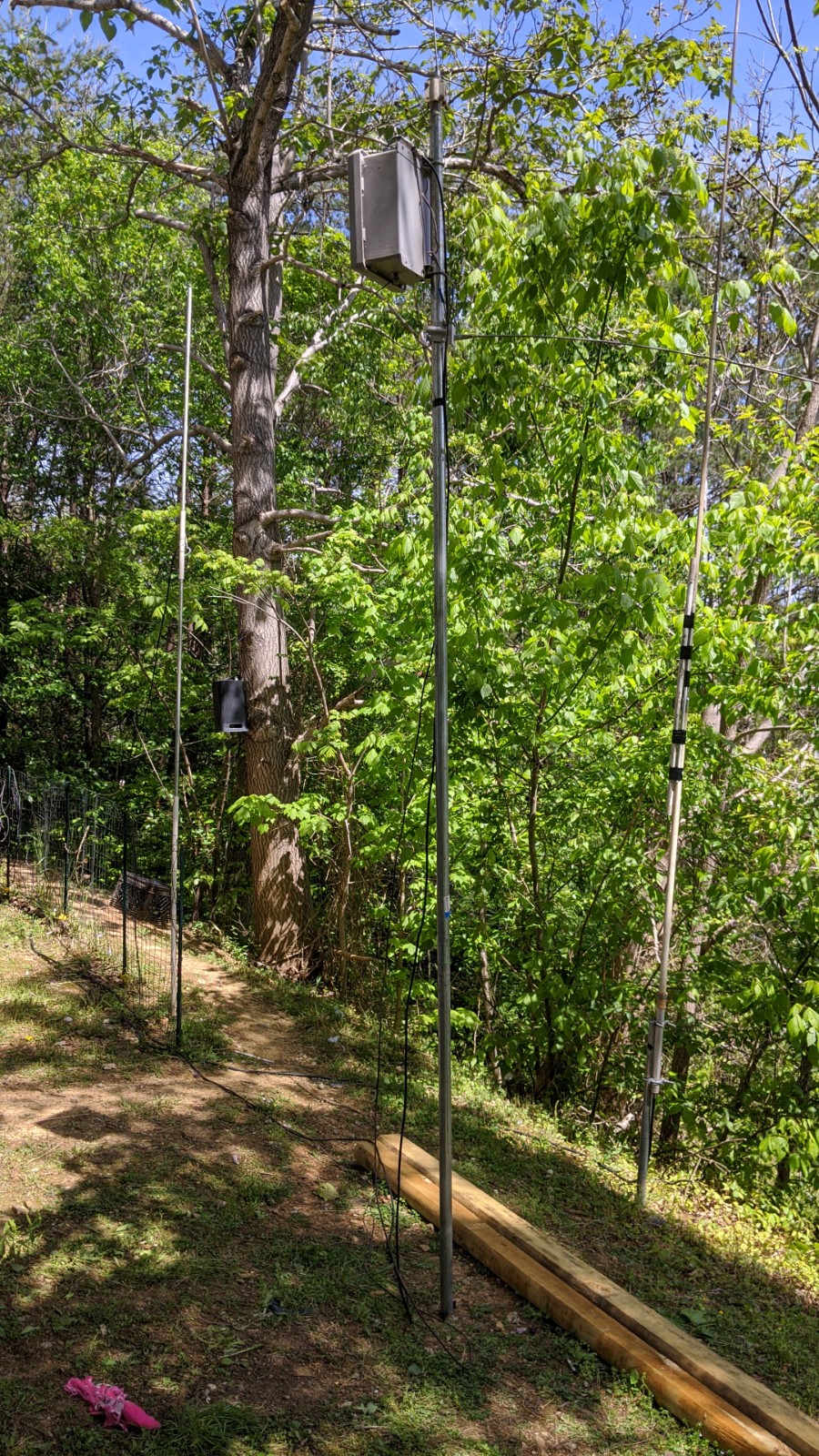


(Note the 6 meter vertical dipole in the picture on the right. It is temp mounted to the garden fence while the Antron 99 is again in the background.)
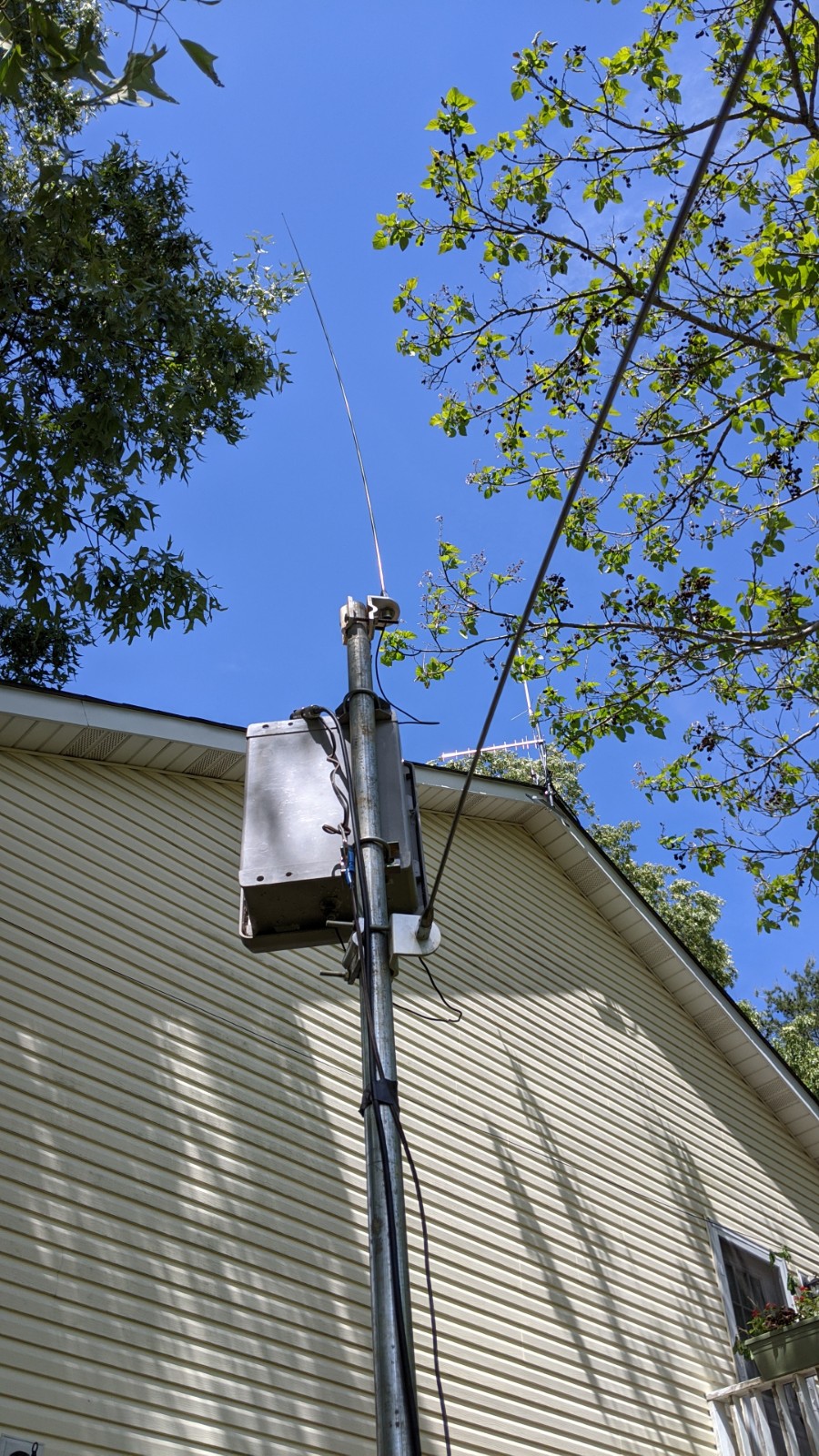
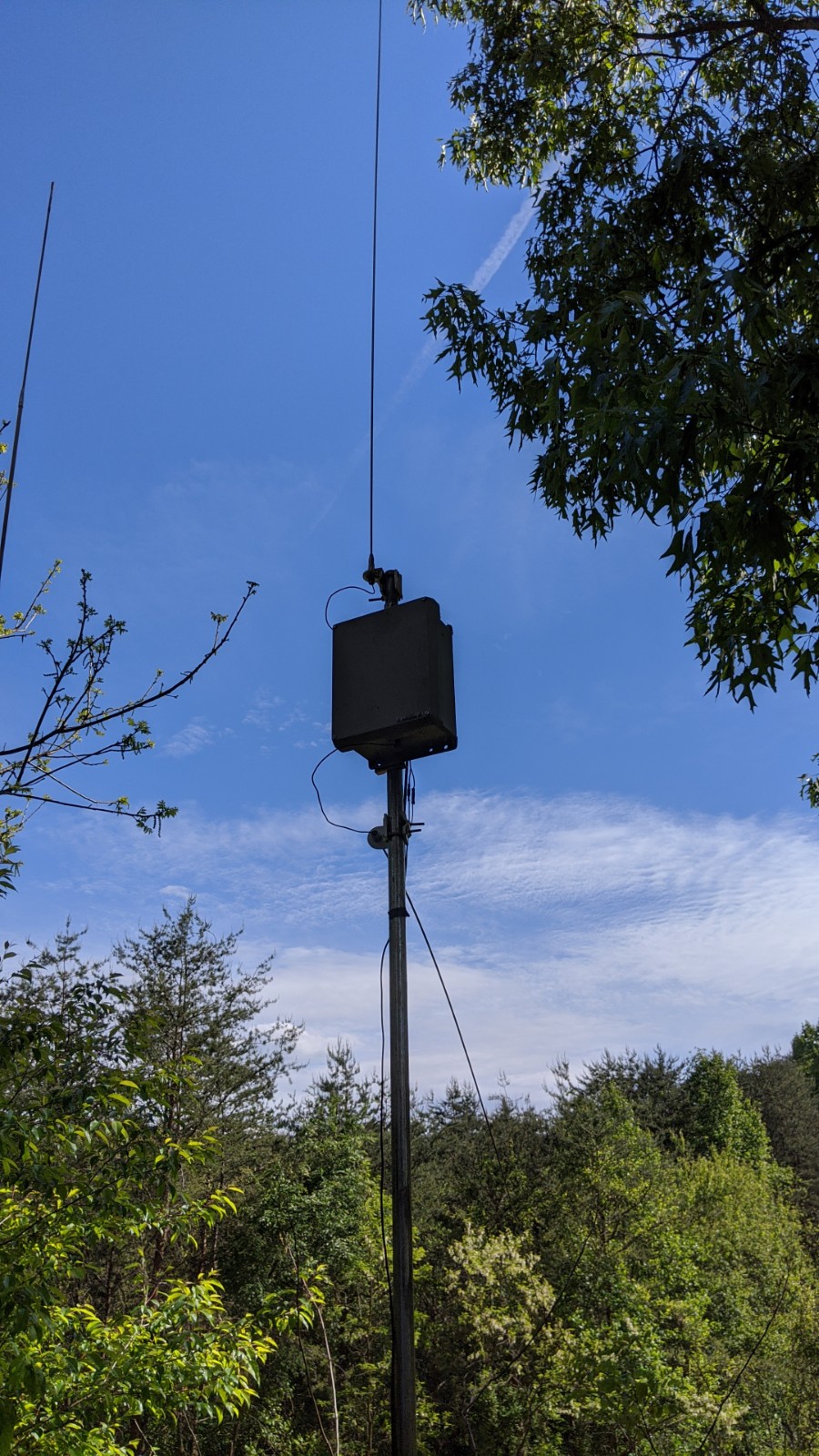


I will be experimenting with it in the current configuration on days the HF bands are more agreeable and hope to fabricate a “V” top mount in the days ahead. Given a taller pole mount, one or more “hamstick dipole mounts could be added below the tunable assembly. 40 meters is the likely candidate but 80 merters could be as well. (At least 1 more cable would be needed for this depending on how the dipole mounts are wired. A desktop tuner such as an LDG AT-100 Pro would be desirable - if working an entire band is needed.) Results with the “L” have been decent given the condition of the bands. On 20 meters it was only 1-2 S units down on the 160 meter loop. On 17 meters it had a better signal to noise ratio on my receive but the loop was more easily heard by the remote station. I have not heard anyone on 15, 12, or 10 meters to test it with so far.


This pic shows a hamstick dipole mount below the tunable assembly. However, I had the dipole mount shorted and was using the two 102” whips as a counterpoise to the 40 meter vertical hamstick above (The SGC 239 was still in line and doing it’s thing.)


Results haven’t been too bad so far for the 40 meter only vertical… 2-4 S units down on a 160 meter horizontal loop with crappy band conditions.


The last picture does show you that a dipole (or two) could easily be mounted below the tunable 20-6 meter section. As a field day set up I would use a rotatable guy system and use at least one more 8’ pole beneath the one used in the assembly. I am in fact planning on cutting the pole below the dipole mount so I don’t have to account for 5-6 feet of pole hanging off the end of the section with all the mounts, etc.


When used, I would take the section with the mounts and place it on the tapered end of an 8’ pole… and then probably hoist that up onto a second 8’ pole to get the base of the “L” or hopefully soon to be “V” antenna up to around 20 feet above ground. An improvised guy system (Armstrong Rotor, naturally) that allows the entire assembly to be turned at least 90 degrees.


I got frustrated with it a few times but had to realize what I was comparing it to - a 160 Loop tuned to 20 meters is a pretty damned good omni-ish antenna… while I’m using 2 ¼ wave 10 meter elements for 20. But it does play and I’m going to set it up in front of the school during the summer a few times to see if I get any drive-by interest.


Steve, W4HKL

www.w4hkl.com


UPDATE:  Even mounted 8' above the ground, this system has worked pretty well on the upper bands... - down 2 to 4 S Units from the loop on 20 but not bad for a tuned 10 meter dipole.  I'm encouraged enough to think the system would work much better with two 16.5' elements instead of the two 102" inch elements I just used because they were available.  I will have to fabricate a mount but I think I can use PCV as an insulator and use two pieces of emt conduit with the 102" whips mounted to the ends for the dipole.  The autotuner will remain mounted below.  The shape will move from an "L" to a "V" dipole.


UPDATE for the UPDATE:

I "ran it up the flagpole" so to speak and found that it pretty much had similar performance to my 33ft elevated vertical antenna.  I was NOT using a rotor with it so I'm sure that effected the results to some degree.  Anyway, I plan on using it for field day and using the AH$ tuner at the antenna feed point instead of tuning it remotely (which I did when I had it mounted on the eave of the house.
Below are the pics of the construction, etc.


Painted and mounted it is not very obtrusive for it's size.


Wednesday, February 06, 2019

Tinymicros

Info on almost everything Amateur Radio related.

http://tinymicros.com/wiki/Main_Page

Kenwood Commercial Radios are what brought me here...


Tuesday, January 09, 2018

N5DUX Ham Resources

Check out this Operator's site.  It is overflowing with interesting and helpful topics.


N5DUX Ham Resources


Be sure to visit his collection of amateur radio related PDFs here.


Steve, W4HKL

Remote Antenna Disconnect


I can see modifying a sliding under-desk computer keyboard tray into something like this.


Amateur Radio Antenna Remote Disconnect for Lightning Protection from alk on Vimeo.


Article Link is here.

Thursday, December 21, 2017

Wide-band WebSDR

On this page you can listen to and control a short-wave receiver located at the amateur radio club ETGD at the University of Twente


http://websdr.ewi.utwente.nl:8901/


[picture of the SDR hardware]

Alternative WebSDRs that can be tuned to SKYKING:
<http://K3FEF.com:8901/> [Loc FN21mh] fq 4724 8992 15016
<http://websdr.printf.cc:8901/> [Loc KO04sd] fq 4724 6739 8992
<http://201.159.93.242:8088/> [Loc GH80Ac] fq 4724 6739 11175
<http://46.241.39.39:8901/> [Loc NO13th] fq 13200 15016
<http://ik8ysw.ddns.net/> [Loc JN70fq] fq 13200 15016
<http://ra4ptj.ru/> [Loc LO64dv] fq 6739 13200 15016
<http://96.242.43.137:8902/> [Loc FN20xd] fq 4724 6739 15016
<http://sdritajai.ddns.net:8080/> [Loc GG53ob] fq 4724 6739 15016


EAMs and HF-GCSBy Ryan Schaum and Marcel H.

http://www.numbers-stations.com/


Numbers Station Info

Military Callsign List


Sunday, December 11, 2016

Digital Voice Links

Beginning to delve into the realm of the digital voice modes.

Below are my links of interest...  so that I can find them again when I actually have the time to work on it!


DV Applications and Ham Radio


DV MEGA3000,    DV MEGA home page


Repeater Builder USB-RIM


Repeater Builder USB-RIM Lite

    RIM-RC210/RLC: Schematic
    Special Limited Time Price - $50 
    This version is customized to be plug-and-play with the ARCOM RC-210 repeater controller. It is also compatable with RLC controllers from Audio Test Solutions (Formerly Link Communictaions). Simply plug the module onto an unused controller port, configure the controller and AllStar config files, and you are ready to explore the world of AllStar linking.
    **Specific connection instructions will be available soon.**

    RIM-Maxtrac-RM: Schematic
    Special Limited Time Price - $60 
    This product is VERY similar to the RIM-Maxtrac. The RM stands for Repeater Maker. The RM adds a second 16 pin module to connect to a second receive only radio. This allows for one radio to be the receiver and the other to be the transmitter in a repeater type setup. The RM version does NOT support channel steering.
  • All of the new Lite version products still inclue the missing pulse detector circuitry to avoid stuck PTT lines. By default, the heartbeat and PTT outputs are configured to allow the missing pulse detector to automatically disable the PTT line in the event of a stuck PTT due to USB PC communications failure.

  • All of these new boards offer an optional serial EEPROM that can be used to store radio/repeater settings.*

  • Courteous and friendly customer service. While product documentation is currently being written, the user's manuals for these products will follow in the same lines as the rest of the RB products in being straight forward and thorough.
  • * Software implementation dependant


    Steve, W4HKL

    Thursday, July 07, 2016

    Creating a Dual Boot Windows 7 / MS-DOS 7.1 System

    Programming the older radios that absolutely need DOS AND a true serial port can be a real pain in the ass.  Although DosBox is wonderful and can work with the USB to serial adapters much of the time, sometimes you just can't go that route.  After spending the better part of two days (!) going thru the motions using GRUB, PLOP, various bootable media, I thankfully ran across the following article which is working for me.  Perhaps it will help you, too.

      TweakhomePC : Install Dual-Boot of MS-DOS 7.10 (FAT32) on Windows 7 computer (Win7 installed first)

    Many thanks to TweakhomePC for ending my misery!


    Steve, W4HKL

    Sunday, December 13, 2015

    All Star

    W4HKL All Star Set Up
    Update 04 July 2020


    All star Node 41538

    146.460 Simplex 100Hz tone.
    (City Limits of Maynardville, TN)

    Node Status

    Graphical Connection List

    Equipment:  Node Radio, Motorola GM300@10 watts, approx 50 ft. LMR-400 to roof mounted 5/8 wave mobile antenna on ground plane kit.

    ---------------------

    All Star Node 45333

    Low Profile 444.675 repeater T100Hz
    (City Limits+  of Maynardville, TN)

    Equipment:  two Motorola PM400 radios, Repeaterbuilder RIM-lite RM, Rasp. Pi 3 using Hamvoip image for controller, Decibel duplexers, 40 ft LMR, Diamond X50A antenna

    Repeater Status

    Graphical Connection List


    ---------------------


    All star Node 43043

    223.400 Simplex.
    (City Limits of Maynardville, TN)

    Node Status

    Graphical Connection List

    Equipment:  Node Radio, Alinco DR 235 @ 5 watts, 1/4 ground plane.


    ---------------------


    All star Node 422560

    900 Mhz Simplex
    (Residence only)

    Node Status

    Graphical Connection List

    Sunday, July 19, 2015

    Updates

    Middlesboro -

    443.950 is off the air until I can replace the antenna.  It appears to have slowly degraded over the past 2 years.  The desense issue has now been eliminated up to the jumper or the repeater antenna.  Info gleaned from the web would indicate that the Diamond 718 antennas can't handle the mountaintop locations for - of all reasons - heavy moisture condensation at altitude.  Go figure.

    Caryville -

    I have decided to go ahead and coordinate the 444.675 (+ offset, 100.0 Tone)  Seems like much ado over nothing considering it's low profile and lack of coverage, but I might as well.

    It is IRLP connected and is parked on the East Coast Reflector 9050 mostly during the day.  At night, it may end up on either the 9109 Alaska Channel or 9070 Alaska Reflector.  Or on 9050.  Feel free to use it.
    73 disconnects while simply inputting the IRLP node or reflector number will connect.
    Just be sure to wait 30=45 seconds before transmitting when you first arrive so as not to inadvertently interrupt a QSO.  If you connect up with something just disconnect after you are through.

    Allstar Node 41538 is running on 146.460 (100.0 Tone.)  I am planning to mount the antenna about 20 feet higher and go with a higher gain antenna - but not too high a gain - we are in the mountains, after all. This node may or may not be connected to an IRLP bridge, another Allstar or Echolink node, or simply idle.  *70 will give you the node status.  If it is in repeat mode, you're set.  If not, *73 will disconnect all.  *3XXXX (xxxx=allstar node number) will connect you to the node number you input.  If you want to use Echolink, shoot me an email.  It's a bit more tricky.

    Future plans -

    Once 950 is back on and working, I will connect it to the Allstar Linking Network.  Why...?  Because we can!!!


    Steve
    W4HKL

    Tuesday, March 24, 2015

    Duplexer Info for the 03/24/2014 East Coast Repeater Net

    This is supplementary info for the East Coast Repeater Net on 03/24/2015.

    Steve Smith, W4HKL

    Topic:  Duplexers


    Below are some pictures of duplexers.

     VHF?
     UHF?  900 Mhz?
    A set of low power duplexers.

    Homebrew duplexers made from old fire extinguishers!


    Links

    Wikipedia :  Duplexer

    Repeater Builder:  Antenna Systems

    6 Meter Homebrew Duplexers Link 1; Link 2


    (Detailed interior diagram of a duplexer)


    PDFs


    (Includes diagram of duplexer interior)


    Youtube


    I hope this collection on information assists anyone looking to further their understanding of duplexers.

    Steve, W4HKL


    (The links, photos, and information used above represents the hard work and dedication of many individuals.  I make no claim of ownership or creation of those links, files, or information. This information is presented purely for the advancement of the Amateur Radio Hobby.  If any of the authors has issues with this information being used here without claim of authorship by myself only for the advancement of the hobby, then contact me and I will immediately remove the offending item.)

    Saturday, January 10, 2015

    TACN

    Tennessee Consolidated Network for Emergency Communications and Technology.


    Everything you wanted to know but were afraid to ask, lol.


    THP          : https://www.tn.gov/safety/tacn.html

    Radioreference Forum for TACN

    More info from Radioreference


    Sunday, August 17, 2014

    443.950 Will Be Back On The Air Soon

    443.950 (T100) Has been off the air for a month or so undergoing renovations courtesy of Henry, WB4IVB. The GE Mastr Exec II reciever has been replaced with an actual GE Master II repeater - along with other improvements and additions.

    The CAT 700 Controller has been replaced with an Arcom 210.  This will run 443.950 in addition to a new 900 Mhz linking repeater.  This repeater is not intended for end users but simply as a means to connect 443.950 to the Lynch KY (Black Mountain) 442.350 (T100) and the Corbin KY 444.900 (T100) UHF repeaters full time.  The 900 Mhz repeater will have limited range for distant vehicular use but will be more than enough for site-to-site linking.  Everything it hears will be re-transmitted on 443.950 which has a much larger coverage area and much better saturation.


     443.950 coverage


    900 Mhz repeater coverage


    As you can see, 440 works better in the mountains than 900 Mhz, although from my use of the KE4KEV and WB4GBI 900 Mhz repeaters in Knoxville and Seymore, the coverage map is probably shortchanging the actual usable mobile coverage by a bit.


    Below are some pics of the actual repeater configuration.  Thanks to WB4IVB for the long hours he put into this project and to AJ4G for space at the site and help with the set up and tower work.


    At the top are the 900 Mhz radios, a Kenwood for Xmit and  Motorola radius for receive.  It sports a true duplexer and is controlled by the Arcom 210.  The antenna is a Comet cfc7-71 with approximately 7 db gain and will be fed with hardline.

    The two older Kenwood mobiles are a TM 241 and TM 341 with various display and memory issues.  This makes them perfect for remote base use, however, and will allow for frequency agile 2 meter and 220 Mhz operation thru the use of the controller and an old Doug Hall Remote Base Interface.

    Next is the GE Mastr II 440 repeater set at approx 50 watts.  Signals will first hit the DCI bandpass filter before the decibel duplexers - including a 3 cavity filter centered on 449.950.   443.950 will have five cans on receive before hitting the ARR preamp...  leaving two for transmit.  The antenna is a Diamond 718 antenna side mounted on the tower at approx. 35 feet currently fed with LMR 600.  Plans are to replace this before winter with hardline.


    Cooling fans.


    Close up of remote base fans.


    Master II prep for heat sink fans.


    Lowes...  for all your repeater needs.


    The thrd tap will be extended to the inside of the cabinet and a fan which will force air directly over the PA transistors and circuits.


    When completed, this will link Middlesboro, Harlan, and Corbin Kentucky almost full-time.  Counties covered to various degrees in Southeastern Kentucky are Bell, Whitley, Laurel, Harlan, and Knox.  In N. E. Tennessee Claiborne, Campbell, Knox, Union, Hawkins, and Grainger counties...  In S.W. Virginia Lee, Scott, Wise counties...


    The links can be taken down (or brought up) for various reasons, including remote base operation for additional linking and IRLP connection.

    Any repeater that wishes to link in through the 900 Mhz hub or through other means should contact w4hkl@live.com or wb4ivb@hotmail.com for more info.  We love to talk amateur radio.

    So when you also consider the well-maintained Wide Area Network stretching from Louisville Ky. down to Knoxville Tn., a UHF user in Eastern Kentucky and Northeast Tennessee has quite a bit of coverage to play with.


    Steve, W4HKL